Disabled Parking Placards and Plates in Virginia: Who Certifies, How to Apply, and What They Allow
Virginia DMV issues temporary, permanent and institutional disabled parking placards, and disabled plates. Temporary and permanent placards are free for citizens. You apply with a certification of disability signed by a physician, physician’s assistant, nurse practitioner, podiatrist or chiropractor, and you submit it by mail, in person at a customer service center, or at a DMV Select office.
At a glance
| Cost | Temporary and permanent placards are free of charge for citizens |
|---|---|
| Certification | Physician, physician’s assistant, nurse practitioner, podiatrist or chiropractor |
| Forms | MED 10 individual · MED 11 organizational · VSA 10 and VSA 54 for veteran disabled plates |
| Where to apply | By mail, in person at a customer service center, or at a DMV Select office |
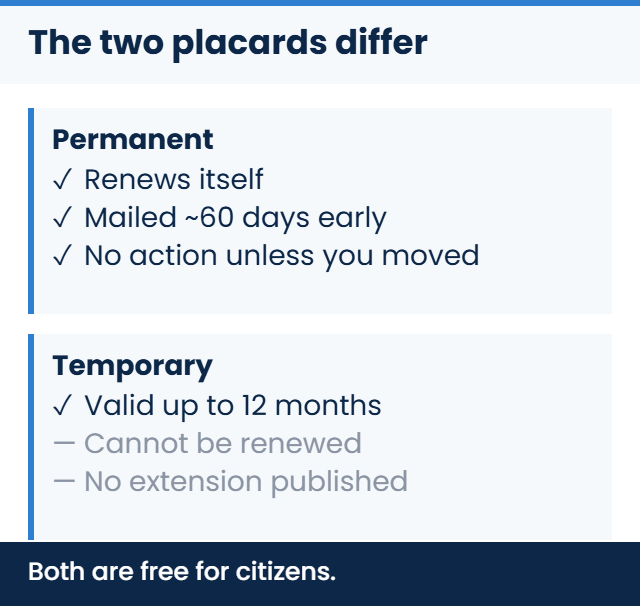
| Temporary placard | Valid up to 12 months and cannot be renewed |
| Permanent placard | Renews automatically and is mailed about 60 days before it expires |
What DMV issues
DMV’s wording is short: “DMV offers temporary, permanent and institutional placards and disabled plates.” Institutional placards are for organizations and institutions operating special vehicles, which is why they use a different form.
Two rules travel with the placard itself. It “must hang from the rearview mirror when the vehicle is in a disabled parking space,” and the placard holder “must be the driver or a passenger.” A placard is not a permit attached to a car; it is attached to a person, and the person has to be in the vehicle.
Who signs the certification — and what DMV does not publish
Your application must include a certification of your disability from a physician, physician’s assistant, nurse practitioner, podiatrist or chiropractor. Podiatrists and chiropractors are limited: DMV says they “may only certify for the conditions or disabilities listed in the certification section provided for podiatrists and chiropractors on the MED 10 form.”
DMV does not publish a list of qualifying conditions. None of the disability pages consulted for this article states who medically qualifies. That judgment sits with the professional signing the form, not with a checklist you can read in advance.
There are two situations where certification is not needed: if you are applying for a license plate showing the International Symbol of Access and you already hold a permanent placard, or if you hold disabled plates and want a permanent placard instead.
How to apply
DMV publishes the requirements and the channels but not a numbered sequence, so the grouping below is ours and the requirements are DMV’s.
Individuals use form MED 10. Organizations and institutions use MED 11. Veterans applying for disabled veteran plates use VSA 10 and VSA 54. Completed applications go by mail to the DMV address in Richmond, in person at any customer service center, or to a DMV Select office. If you are going in person, our list of Virginia DMV office locations covers where they are.
One distinction worth carrying: DMV does not describe an online route for the initial application. On the pages consulted here, online appears only for replacing a temporary placard, which is a different transaction.
What the placard lets you do
DMV publishes two privileges, and the second one has a carve-out that matters.
You may park in any space designated for a disabled person. You may also “park for up to four hours in metered or time-restricted spaces without paying a fee (unless prohibited by the locality).”
Read that bracket. The four-hour meter privilege is not unconditional — DMV attaches it to whether the locality prohibits it. Two towns can treat the same placard differently, so it is worth knowing your locality’s rule rather than assuming the four hours travels with you.
Where it does not work, and what misuse costs
A placard does not allow you to stop, stand or park where parking is prohibited, including areas marked with painted diagonal lines, in spaces reserved for other special types of vehicles, or anywhere it “would clearly present a traffic hazard.”
Use is limited to the person with a disability, or to someone transporting the person the placard or plates were issued to. DMV publishes the penalties for getting this wrong:
- Parking where it is not permitted: a fine of $100 to $500
- Using someone else’s placard: up to $500, and possible revocation of the privilege
- Counterfeiting or altering a placard, or making false statements: up to $1,000 and up to six months in jail, plus possible revocation
Renewal is not the same for both
This is the part most worth knowing in advance, because the two placards behave in opposite ways.
Permanent placards renew themselves. DMV says a permanent placard “will be automatically renewed and mailed to the address on file with DMV approximately 60 days before its expiration date. No action is required unless your address has changed.” That last clause is the one to act on — a stale address is the way an automatic renewal goes missing.
Temporary placards do not renew at all. DMV states they “are valid for up to 12 months and cannot be renewed.”
If a permanent placard is lost or damaged, DMV says a certification from a physician, physician’s assistant, nurse practitioner, podiatrist or chiropractor is not required to replace it. A temporary placard with more than 30 days remaining can be replaced online, by mail, or in person at a customer service center or DMV Select office.
Common questions
How long is a permanent placard actually valid?
DMV does not publish the validity period on the pages consulted for this article. What it does publish is the renewal behavior: DMV says the replacement is mailed about 60 days before the current one expires, without you asking.
My temporary placard is about to run out and I still need one. What then?
DMV says a temporary placard cannot be renewed, and it does not describe an extension. It also does not say a fresh application is barred. Since the pages consulted stop there, this is a question to put to DMV rather than one to answer from the published wording.
My address changed. What happens to the automatic renewal?
DMV’s wording puts the burden here squarely on the address: “No action is required unless your address has changed.” The pages consulted for this article do not describe what happens once a renewal has already been mailed to an old address, so if yours has moved, update it with DMV well before the 60-day mark rather than waiting to see whether the placard arrives.
Will my Virginia placard be honored in another state?
None of the DMV pages consulted here addresses recognition outside Virginia. Virginia’s rules — including the four-hour meter privilege and its locality carve-out — are written for Virginia, and the pages make no claim about anywhere else.
Official sources
- Virginia DMV — Parking Placards and Plates
- Virginia DMV — Applying for a Disabled Parking Placard or Plate
- Virginia DMV — Privileges and Rights
- Virginia DMV — Renewal and Replacement
Official sources last verified: September 9, 2026. Placard rules, forms and penalties are set by DMV and the Code of Virginia and can change — confirm current details with DMV, and check your locality for metered-parking rules.