Keeping Your Virginia Driver’s License While You Live or Serve Outside Virginia
If you hold a Virginia driver’s license and you are living or serving outside the state, DMV publishes two separate no-fee requests, and they solve different problems. A license extension pushes your expiry date out six years, and DMV limits it to three groups. A Non-Virginia Address Exception lets you keep a Virginia credential while your mailing address is somewhere else, and it covers a much wider group — including students and people working away temporarily.
Extension or address exception?
| What | License extension | Non-Virginia Address Exception |
|---|---|---|
| What it does | Extends your license for six years | Lets your credential carry a non-Virginia address |
| Fee | None | None |
| How many times | One extension only | DMV’s page does not state a limit |
| Who it covers | Military, diplomatic service, US government civilians — plus spouse and dependents | Those groups plus students, temporary workers, family reasons, some border residents |
| Form | DL 1P | DMV 143 |
They are not alternatives to each other. DMV’s address exception page frames an extension as something you may also want to request, so the two are handled as separate requests.
The Virginia license extension: a narrow door, and the geography matters
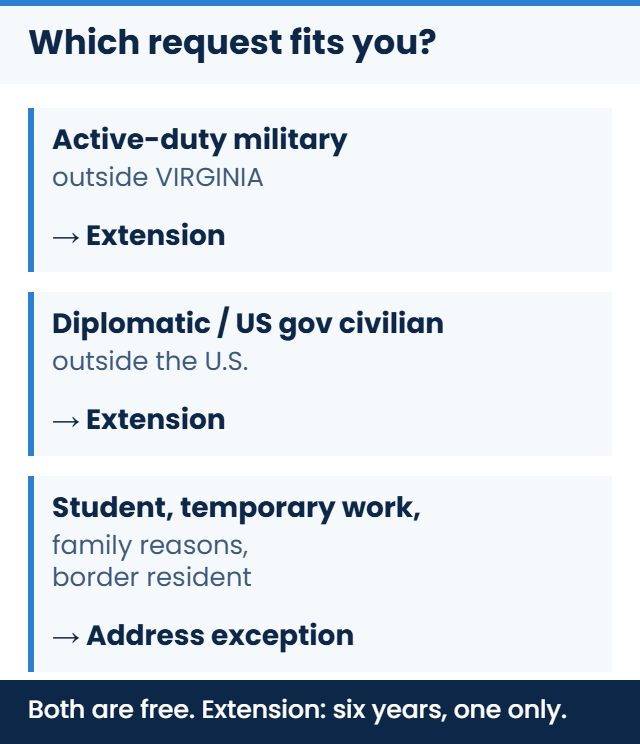
DMV lists three groups who may request an extension. Read the geography carefully, because it is not the same test for each:
- Active duty military serving outside the Commonwealth of Virginia — or their spouse and dependents.
- Members of the US diplomatic service serving outside the U.S.
- Civilian employees of the US government, or any agency or contractor of it, serving outside the U.S.
That difference is easy to miss and it decides eligibility. A service member stationed in another state is outside Virginia and within DMV’s wording. A government civilian employee working in another state is not outside the U.S., so the extension route as DMV describes it does not reach them.
DMV also names three situations that rule you out: holding a commercial driver’s license, holding a limited duration license, or being required to register under the Sex Offender and Crimes Against Minors Registry Act.
DMV states the terms plainly: six years, and only one extension may be granted. There is no fee.
What you send, and where
DMV documents the requirements on two pages and does not publish them as a numbered sequence. The grouping below is ours; the requirements are DMV’s.
Extension applicants use the Driver’s License and Identification Card Application, form DL 1P. For military applicants, DMV describes the route as applying by mail, and the supporting documents differ depending on whether you are the service member or a dependent.
If you are the active duty member: a copy of your military identification card, and either a copy of your military orders or a certification letter on US government letterhead, signed by your commanding officer or supervisor, containing your name and stating that you are active duty and stationed outside Virginia.
If you are a spouse or dependent: a copy of the active duty member’s military ID card, a copy of your own dependent military ID card, and either current military orders listing your name or a certification letter on US government letterhead signed by the active duty member’s commanding officer.
DMV’s general extension page describes the same shape for the non-military categories — the application, proof of who you are, and either current travel orders showing your name or a certification letter on government letterhead signed by your or your spouse’s commanding officer or supervisor.
The address exception covers people the extension does not
DMV’s starting point is a single requirement: “If you hold a Virginia driver’s license or photo identification (ID) card, you must have a Virginia residence/home address.” The Non-Virginia Address Exception is the route DMV publishes for people who need a non-Virginia mailing address anyway.
Its list is noticeably wider than the extension’s. Alongside active members of the US armed forces and their spouse and dependents, and US citizens employed outside the United States and their spouse and dependents, DMV lists:
- Students enrolled at a college or university outside Virginia
- People temporarily employed outside Virginia
- People temporarily located outside Virginia for family reasons
- Border residents required by the US Postal Service to maintain a non-Virginia mailing address
There is no fee, and DMV points to form DMV 143 for the eligibility and proof documents. DMV does not state how long the exception lasts.
Coming back: the 180-day rule
The extension has one deadline attached to the end of it, and it is worth writing down now rather than finding later. DMV’s wording: “When you return to Virginia, you must visit a DMV customer service center within 180 days of your return to renew your license.”
That is an in-person visit to renew, not an online transaction. If your return renewal is coming up, our guide to renewing a Virginia driver’s license online or in person covers which conditions push a renewal in person anyway.
What DMV’s pages do not say
Four gaps matter here, and each one is a question a reader in this situation actually has.
Renewing while you are away. DMV’s page for people temporarily outside Virginia lists three options — get an extension, get an address exception, or replace your license. Renewing from outside the state is not among them, and the page does not discuss it. That silence is not permission in either direction; ask DMV about your own case.
What happens if you miss the 180 days. DMV states the deadline and does not state a consequence.
Whether anything follows the six years. DMV does not describe what a person does at the end of a six-year extension if they are still posted away.
How long the address exception lasts. DMV’s page does not give a duration or a renewal procedure for it.
Common questions
I am in the military but stationed in another US state, not overseas. Do I qualify?
DMV’s wording for the military category is “serving outside of the Commonwealth of Virginia,” which is a different test from the “outside of the U.S.” wording it uses for the diplomatic and civilian government categories. Another state is outside Virginia. Confirm your own case with DMV before mailing anything.
I am a student at a university out of state. Can I get an extension?
Students are not on DMV’s extension list. They are on the Non-Virginia Address Exception list. Those are two different requests with two different forms, so the answer for a student is the exception, not the extension.
What happens if I get back to Virginia and miss the 180 days?
DMV publishes the deadline and does not publish a consequence for missing it. None of the pages consulted for this article says what changes at day 181, so if you are close to that line, ask DMV rather than assuming the visit can wait.
Does an extension let me drive in the state or country where I am posted?
Nothing on the DMV pages consulted here addresses that. An extension is described as extending your Virginia license, and whether that license is accepted where you are living is a question for the licensing authority there, not for Virginia DMV.
Official sources
- Virginia DMV — License Extension
- Virginia DMV — Military License Extension
- Virginia DMV — Non-Virginia Address Exception
- Virginia DMV — Temporarily Outside of Virginia
Official sources last verified: September 9, 2026. Eligibility wording and document lists are set by DMV and can change — confirm your own case with DMV before you mail an application.