Virginia DMV Demerit Points: How They Work
Virginia DMV demerit points land on your record when a court reports a traffic conviction, and they come off two years from the date you committed the offense. The conviction itself stays longer — 3, 5 or 11 years depending on the violation, and in some cases permanently. Those are two different clocks, and mixing them up is the most expensive mistake on this subject.
At a glance
| What you want to know | What DMV publishes |
|---|---|
| Point values | Three, four or six, “according to the severity of the offense” |
| Out-of-state tickets | “Demerit points will also be assigned to your record for traffic convictions incurred in other states” |
| Suspension | 90 days at 18 points in 12 months, or 24 in 24 |
| Safe driving points | One per clean calendar year, awarded each April; maximum five |
How a point gets onto your record
DMV does not decide you were speeding. A court does, and then tells DMV. DMV’s own description of the sequence is short: when you are convicted of a traffic violation, “the court notifies the Department of Motor Vehicles (DMV), who does the following: Posts the conviction to your driving record [and] Assigns you demerit points according to the severity of the offense.”
Two consequences of that are easy to miss, and DMV states both plainly.
- A ticket from another state still counts. “Demerit points will also be assigned to your record for traffic convictions incurred in other states.”
- Violations that carry no points are still recorded. “DMV also posts to your record traffic violations that do not carry demerit points.” A clean point total does not mean an empty record.
The points follow a Virginia traffic ticket only once it has become a conviction the court reports.
The two clocks on a demerit point
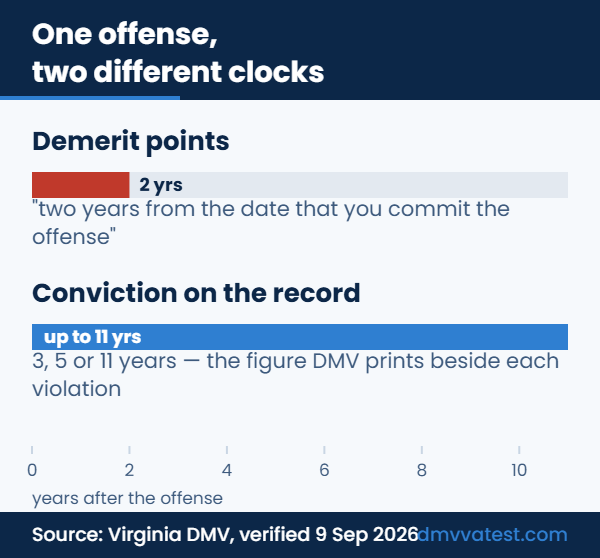
This is the part that costs people money, because the two numbers are different and both are true.
The points clock. “DMV demerit points remain on your record for two years from the date that you commit the offense.” Note where it starts — the offense date, not the conviction date, and not the date you paid anything.
The conviction clock. On each of DMV’s point-level pages the retention period sits in brackets after the violation: “The number of years that the conviction stays on your DMV record is in parentheses beside each violation.” Three years is common, five is common for speeding, six-point convictions run to 11 years, and an asterisk marks a conviction that “remains on your record permanently.”
So a speeding conviction can stop counting toward a suspension while still being visible on the record for years afterwards. The points expiring is not the record clearing.
Three, four or six points
DMV publishes three levels, each on its own page, with the conviction retention period beside every entry. These are examples, not the lists — DMV publishes dozens of violations and states that “the violations listed may change without notice.”
| Level | DMV examples | Conviction stays |
|---|---|---|
| 3 points | “Speeding 1-9 mph above the posted speed limit” · “Improper passing” · “Failure to obey highway sign” | 3 years, or 5 for the speeding entry |
| 4 points | “Speeding 10-14 mph above the posted speed limit” · “Following too closely” · “Passing stopped school bus (non-reckless)” | 3 or 5 years |
| 6 points | Reckless driving · driving under the influence · manslaughter · habitual offender and license offences · certain commercial violations | 11 years or 3 years depending on the entry; an asterisk means permanent |
What happens as the points add up
For a driver 18 or over, DMV publishes three thresholds, and each one is measured two ways — over 12 months and over 24.
| What your record shows | What DMV does |
|---|---|
| 8 points in 12 months (or 12 in 24) |
Sends an advisory letter |
| 12 points in 12 months (or 18 in 24) |
Requires a driver improvement clinic. “You must enroll in and satisfactorily complete the clinic within 90 days” |
| 18 points in 12 months (or 24 in 24) |
“your driving privilege will be suspended for 90 days” |
After a suspension is served and the privilege is restored, DMV states that “once your privilege is restored, you will be placed on a six-month probation period.”
If you are under 18
The under-18 ladder does not run on point totals at all. DMV attaches each step to a conviction.
- First demerit-point conviction — a driver improvement clinic is required. “If you do not satisfactorily complete the clinic within 90 days, DMV will suspend your permit or license until the clinic is completed.”
- Second — “DMV will suspend your permit or license for 90 days.”
- Third — “DMV will revoke your permit or license for one year or until you reach age 18, whichever is longer.”
The safe-driving-point rule is also inverted under 18: “You will receive 5 safe driving points if you voluntarily complete a driver improvement clinic. However, safe driving points will not be awarded if clinic attendance was required by DMV or a court.”
Safe driving points — and what the sources do not say
Virginia’s record carries a positive side. DMV: “One safe driving point is assigned for each full calendar year that you hold a valid Virginia driver’s license and drive without any violations or suspensions.” They arrive on a schedule — “annual safe driving points are awarded in early April of each year for the previous calendar year” — and a driver may hold a maximum of five. Completing a driver improvement clinic can earn five at once.
Here is the honest limit of what DMV publishes. DMV describes demerit points and safe driving points on the same page without setting out a rule by which one cancels the other. It is widely said that safe driving points offset demerits; none of the DMV pages consulted for this article states that mechanic, so this article does not claim it. If the arithmetic of your own record matters — for a threshold, a hearing or a job — DMV is the place to have it confirmed against your actual record.
Frequently asked questions
DMV sent me a letter about my points but nothing else happened. What is it?
At 8 demerit points in 12 months, or 12 in 24, DMV sends an advisory letter. On the page consulted for this article DMV attaches no action to it — no clinic, no suspension, no deadline. It is a notification that the next thresholds are 12 points and 18. Treat it as information about where you now sit, not as something to respond to.
Can I appeal a DMV order about points?
There is a statutory route. § 46.2-489 provides that a person who receives an order from the Commissioner about a suspension, a revocation, clinic attendance or probation may “file a petition of appeal in accordance with § 46.2-410” — and the Code sets that window at thirty days from the date of the order. This article is not legal advice; if you intend to use it, act on the date rather than the deadline.
Will demerit points raise my insurance?
None of the DMV pages consulted for this article addresses insurance at all. DMV’s point system governs advisory letters, clinics, suspensions and probation. What an insurer does with a conviction on your record is a matter between you and the insurer, and it runs on the conviction’s retention period rather than the two-year point clock.
If I just pay the ticket, do I avoid the points?
DMV’s trigger is the conviction the court reports — “when you are convicted of a traffic violation, the court notifies” DMV. Whether a particular way of resolving a ticket counts as a conviction is a court question, and nothing on the DMV pages consulted for this article addresses it. Ask the court that issued the summons before assuming either way.
Official sources
Official sources last verified: 9 September 2026. DMV states that its violation lists “may change without notice” — confirm anything that affects a decision against DMV’s live pages before you act on it. This article is general information, not legal advice.
- Virginia DMV — Moving Violations and Point Assessments
- Virginia DMV — The Points System
- Virginia DMV — Three Point Violations
- Virginia DMV — Four Point Violations
- Virginia DMV — Six Point Violations
- Virginia DMV — Traffic Violations, Drivers Age 18 and Over
- Virginia DMV — Traffic Violations, Drivers Under Age 18
- Code of Virginia § 46.2-489 — Regulations; appeals