How to Get a Virginia Motorcycle License (Class M)
A Virginia motorcycle license is not a separate license at all: it is a Class M designation on a Virginia driver’s license. DMV publishes two routes for adults — a Virginia Rider Training Program course, or its own four-step route through the motorcycle knowledge exam, a learner’s permit and the road skills test. Under 18, a training certificate does not shorten the nine-month permit period.
At a glance
| What you want to know | What DMV publishes |
|---|---|
| Knowledge exam | 25 questions from the Motorcycle Operator Manual, taken on a computer |
| Training certificate | Valid one year; within that year no motorcycle knowledge or road skills exam is required |
| Fee | “an annual fee”, running for the same period as your driver’s license. DMV does not publish a figure on this page |
| Moving to Virginia | “Virginia does not accept out-of-state motorcycle safety course certificates” |
The two routes to a Virginia motorcycle license
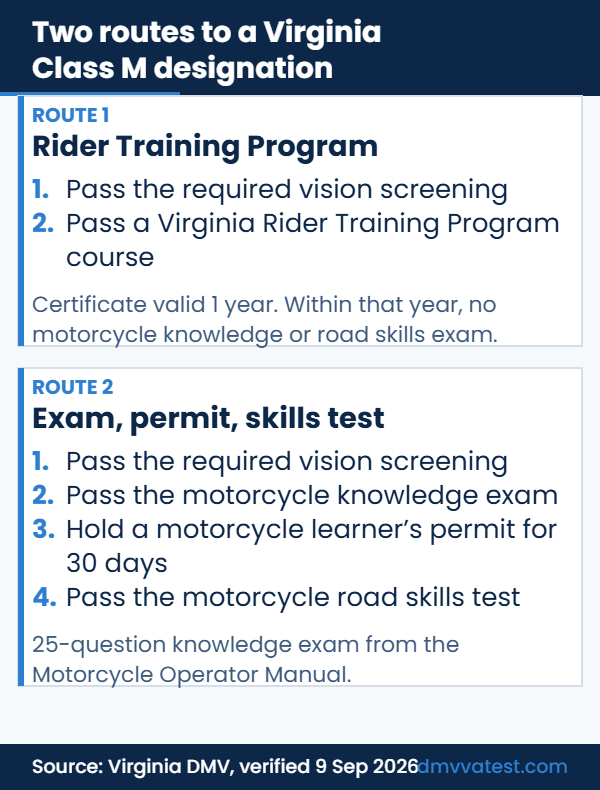
These are DMV’s own numbered lists for adult applicants, reproduced in the order DMV gives them. The under-18 route is covered further down.
Route 1 — the Rider Training Program
- “Pass the required vision screening”
- “Pass a Virginia Rider Training Program course”
The Rider Training Program is “certified by the Motorcycle Safety Foundation” and offers “comprehensive courses designed for riders at all levels.”
The completion certificate does two things. It is “valid for one year from the date of completion”, and within that year a rider “will not be required to complete the motorcycle knowledge or road skills exam.”
Route 2 — knowledge exam, permit, skills test
- “Pass the required vision screening”
- “Pass the motorcycle knowledge exam”
- “Hold a motorcycle learner’s permit for 30 days”
- “Pass the motorcycle road skills test”
DMV’s learner’s permit page states the same holding period from the other direction: “you must obtain and hold a motorcycle learner’s permit for at least 30 days.”
Neither route is described by DMV as faster, cheaper or easier than the other, and this article does not rank them. They differ in what they ask of you, not in a quality DMV publishes.
M, M2 or M3 — what the letter means
The classification is not one thing. DMV publishes three:
| Class | What DMV says it covers |
|---|---|
| M | “Both two and three-wheeled motorcycles” |
| M2 | “Only two-wheeled motorcycles” |
| M3 | “Only three-wheeled motorcycles” |
The Code of Virginia requires that restriction to be shown on the classification: a motorcycle classification “shall indicate as applicable a further restriction to a two-wheeled motorcycle only or a three-wheeled motorcycle only.” § 46.2-328 also requires a motorcycle applicant to “submit to and pass the examination provided for in § 46.2-337.”
What the knowledge exam is
DMV publishes the shape of it plainly: “The knowledge exam consists of 25 questions based on information in the Motorcycle Operator Manual”, and it “is offered in several languages and is taken on a computer.”
DMV does not publish a passing score on that page, and this article does not invent one. The Motorcycle Operator Manual is the study material DMV names, and DMV also points riders to its own online sample motorcycle exam.
One rule is worth knowing before you sit down: “If you use a cell phone while taking the exam, the exam will be terminated and you must wait until the next day to re-test.”
What to bring to the road skills test
The motorcycle road skills test is not the car road skills test — it is a separate examination on your own machine, and DMV provides a scheduling page for it. Our guide to the Virginia DMV road skills test covers the car version; what follows is what DMV lists for the motorcycle one.
- “A DOT-approved helmet with a face shield and safety glasses or goggles”
- “Your motorcycle with a valid license plate and a current inspection sticker”
- “Protective clothing: long-sleeved jacket, riding gloves, long pants and boots or shoes that cover your ankles”
The test itself “includes exercises that measure your ability to handle a motorcycle, including starting, accelerating, shifting, turning, braking and swerving.”
And the consequence DMV attaches to failing it twice:
“If you fail the DMV motorcycle road skills test twice, you must complete a Virginia Rider Training Program before adding a Class M Designation to your driver’s license.”
Riding on a motorcycle learner’s permit
The permit is a real permit, with real limits. DMV publishes these:
- Supervision. “You must be supervised by a person at least 21 years of age who is licensed to operate a motorcycle, who is alert and able to assist you and is supervising from a separate accompanying motor vehicle.”
- No passengers. “You cannot carry passengers with a motorcycle learner’s permit.”
- Gear. An approved safety helmet, plus eye and face protection.
The supervision rule is easy to read too quickly: DMV places the supervising rider in a separate accompanying motor vehicle, not on the back of your motorcycle — which the passenger rule rules out in any case.
Once you are licensed, the gear requirements do not go away. DMV states that “motorcyclists in Virginia (both operators and riders) must wear an approved protective helmet”, and that “the operator must either wear a face shield or safety glasses/goggles, or the motorcycle must be equipped with a windshield type approved by the Virginia State Police.”
Special cases
If you are under 18
The point DMV makes explicitly is that the training course does not remove the nine-month permit requirement for a minor: “If you provide DMV with a Virginia Rider Training Program certificate of completion, you are still required to hold a motorcycle learner’s permit for nine months.”
If you are moving to Virginia
A motorcycle safety course completed in another state does not carry over. DMV: “Virginia does not accept out-of-state motorcycle safety course certificates.”
The Code’s temporary motorcycle classification
The takeaway. § 46.2-328 provides a temporary motorcycle classification: a Virginia driver’s license carried with documentation of a completed rider safety training course counts for 30 days from the completion date.
Two details the Code adds that DMV’s route page does not. The statute names “a person 19 years of age or older” — not the same as the adult threshold DMV describes for the training route, so if you are 18, confirm with DMV which applies to you. It also names a second qualifying document: proof of US Armed Services membership — as a member, spouse or dependent — together with a completed approved basic motorcycle rider course.
Neither point is resolved here. Read § 46.2-328 in full.
Frequently asked questions
Can I ride to the DMV for my road skills test on a learner’s permit?
DMV sets both conditions but does not say how to combine them. A motorcycle learner’s permit requires supervision “from a separate accompanying motor vehicle” and does not allow passengers, while the road skills test requires “your motorcycle with a valid license plate and a current inspection sticker”. Nothing on the pages consulted for this article explains how the machine is expected to get there, so raise it with DMV when you schedule the test.
I failed the motorcycle road skills test once. Do I have to take the rider course now?
DMV attaches that consequence to a second failure: “if you fail the DMV motorcycle road skills test twice, you must complete a Virginia Rider Training Program before adding a Class M Designation to your driver’s license.” DMV’s skills test page publishes no waiting period between attempts, so confirm timing with DMV rather than assuming one.
Does DMV provide a motorcycle for the road skills test?
DMV’s list of what to bring names “your motorcycle with a valid license plate and a current inspection sticker”. Nothing on that page offers a DMV-supplied machine, so plan on getting your own there — plated, inspected, and ready to ride.
My rider course certificate is 18 months old. Can I still use it?
Not for the exam waiver. DMV states that certificates are “valid for one year from the date of completion”, and it is within that year that a rider “will not be required to complete the motorcycle knowledge or road skills exam.” Past a year the waiver is gone — DMV’s standard adult route then applies: the knowledge exam, the learner’s permit period and the road skills test.
Official sources
Official sources last verified: 9 September 2026. Requirements, fees and testing rules change — confirm anything that affects a decision against DMV’s live pages before you act on it.
- Virginia DMV — Getting a Motorcycle License
- Virginia DMV — Motorcycle License
- Virginia DMV — Motorcycle Learner’s Permit
- Virginia DMV — Motorcycle Knowledge Exam
- Virginia DMV — Motorcycle Road Skills Test
- Virginia DMV — Operating a Motorcycle in Virginia
- Virginia DMV — Motorcycle Safety and the Virginia Rider Training Program
- Code of Virginia § 46.2-328