Virginia Driver Privilege Card: Who Qualifies and How to Apply
A driver privilege card lets a Virginia resident who is not a US citizen drive legally, without proving legal presence. DMV calls it “a driver’s license for non-US citizens.” It costs $50, it is valid for up to eight years, and no applicant is eligible for a waiver of any part of the driver examination — the knowledge exam and the road skills test apply however long you have driven elsewhere.
At a glance
| What you want to know | What DMV publishes |
|---|---|
| Fee | “$50 for your first driver privilege card and $50 for each renewal” |
| Minimum age | 16 years and 3 months for the card; 15 years and 6 months for the learner’s permit |
| How long it lasts | Expires on your birthday, valid “for up to eight years, or 5 years if you are 75 years old” |
| Where you apply | In person, at any DMV customer service center, on Form DL 10 |
| Tax requirement | Virginia-source income reported, or claimed as a dependent, on a Virginia return in the past 12 months |
| Exams | Knowledge exam and road skills test. No waiver is available |
| Federal ID | Not REAL ID-compliant — cannot board a flight or enter a secure federal facility |
Who this applies to
DMV publishes four conditions, and all four have to be true:
- “You are a non-US citizen who is a resident of Virginia”
- “You have reported income from Virginia sources or are claimed as a dependent on a tax return filed in Virginia in the past 12 months”
- “Your driving privilege is not currently suspended or revoked in Virginia or any other state, and you do not have any insurance-related infractions”
- “You are 16 YEARS and THREE months or older”
The tax condition is checked, not taken on trust. DMV describes the mechanism plainly: during verification, “the Department of Taxation will provide the date when your last return was accepted,” and “this date must be within one year of the date you are applying for a driver privilege card.”
That makes the tax return worth checking before you go. It is a rolling twelve-month window measured from your application date, not a calendar year — so a return accepted thirteen months ago does not qualify you today.
What you need to bring
DMV lists four categories of document alongside the application form:
- Two proofs of identity
- Two proofs of Virginia residency
- Proof of your Social Security number — “if you have been issued one” — or your individual taxpayer identification number
- Tax return documentation
The form is DL 10, the Driver and Identification Privilege Card Application, and DMV’s instruction is to “submit completed application and all required documents to any DMV Customer Service Center.”
DMV maintains its own lists of which specific documents it accepts in each category. Check those lists against what you actually hold before you travel — the categories above say how many of each you need, not which ones count.
How to apply, step by step
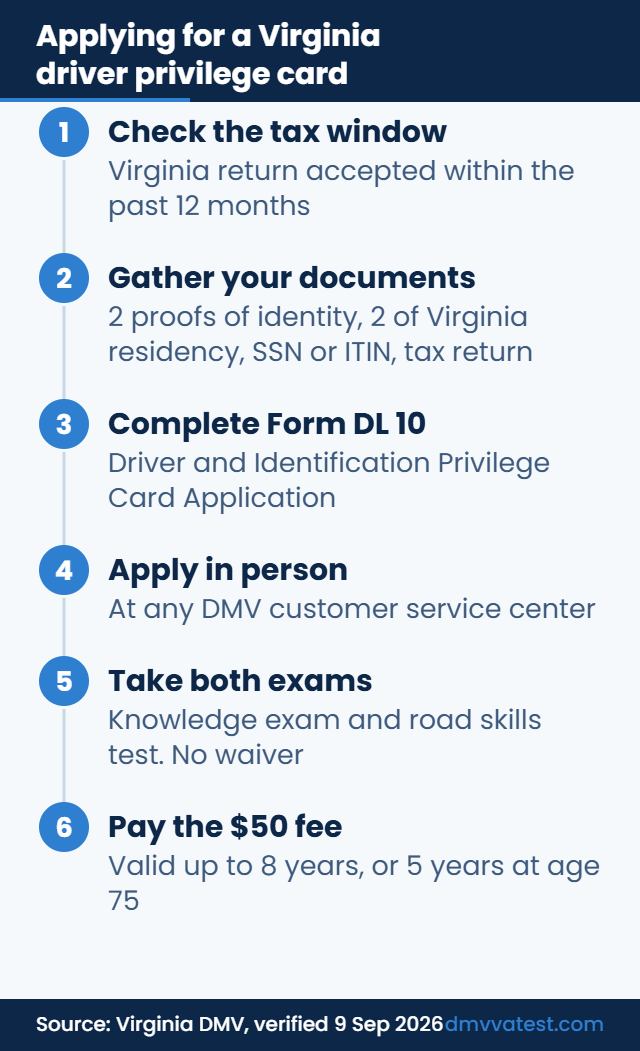
These are the requirements DMV publishes, arranged in a workable order. How much of the sequence applies to you depends on your age and on what you already hold, and DMV confirms that at the counter:
- Check the tax window. Confirm a Virginia return reporting Virginia-source income — or one on which you are claimed as a dependent — was accepted within the past twelve months.
- Gather the four document categories and complete Form DL 10.
- Apply in person at a DMV customer service center. DMV verifies the tax condition with the Department of Taxation as part of the process.
- Take the knowledge exam and obtain a learner’s permit — DMV publishes a learner’s permit minimum age of 15 years and 6 months.
- Complete the driver training or holding period that applies to you (see below), then pass the DMV road skills test.
- Pay the $50 fee and receive the card.
The exams: nobody skips them
A driver privilege card applicant cannot have any part of the driver examination waived.
Both official sources say so, in almost the same words. DMV: “individuals applying for a Driver Privilege Card are not eligible for any exemption from the driver examination. As a result, they are required to complete a road skills test administered by the DMV.” And § 46.2-328.3: an applicant “shall not be eligible for a waiver of any part of the driver examination provided under § 46.2-325.”
A license from another country, or years of experience, does not change this. The knowledge exam and the road skills test both apply.
The examination in question is the one § 46.2-325 provides for — the same statutory driver examination the Code applies to license applicants generally — and the knowledge half of it is the part you can prepare for entirely in advance. Our free Virginia DMV practice test covers that material.
If you are under 18
DMV states the age difference directly: “Virginia law requires all applicants under 18 to complete driver’s education. Adults (18 and older) are not required to take driver’s education.” Our guide to Virginia driver education requirements covers what that course involves. That guide describes Virginia’s general driver education rules, including exemptions that exist in other circumstances; DMV’s privilege card page states the under-18 requirement without listing any, so confirm your own position with DMV.
Two further differences DMV publishes:
- Juvenile applicants under 18 “must still hold their learner’s permit for 9 months.”
- Adults 18 and over “can waive the learner’s permit holding period with a Driver Training Certificate (DTS D).”
One caution that applies at any age: DMV states that holders of a driver privilege card “cannot drive alone with just a DTS B and learner’s permit.”
What the card does — and what it does not do
Two official statements sit side by side here, and both are true. They are about different things.
On driving, the Code is direct: driver privilege cards “shall confer the same privileges and shall be subject to the same provisions of this title as driver’s licenses and permits issued under this chapter, unless otherwise provided.”
On identification, DMV is equally clear: “A driver privilege card is not REAL ID-compliant, so it cannot be used as identification to board a flight or enter a secure federal facility.”
So: the same right to drive, under the same traffic laws — and a credential DMV says “cannot be used as identification to board a flight or enter a secure federal facility.” Nothing in the sources consulted for this article addresses any other use, such as voting, employment eligibility or public benefits, and this article makes no claim about them.
| Driver privilege card | ID privilege card | |
|---|---|---|
| Lets you drive | Yes | No — DMV calls it “a non-driving ID credential” |
| Fee | $50 | $25 |
| Exams | Knowledge exam and road skills test, no waiver | None |
| REAL ID | Not compliant | Not compliant |
You cannot hold both. DMV’s rule is one sentence: “You may hold either a driver privilege card, or an ID privilege card, but not both.”
What the law says about your application documents
Here the statute is reproduced rather than summarised. § 46.2-328.3(C) has two paragraphs, and they do different things. Read both.
“The Department shall not release the following information relating to the issuance of a driver privilege card or permit, except upon request by the subject of the information, the parent of a minor who is the subject of the information, the guardian of the subject of the information, or the authorized representative of the subject of the information, or pursuant to a court order, (i) proof documents submitted for the purpose of obtaining a driver privilege card or permit, (ii) the information in the Department’s records indicating the type of proof documentation that was provided, or (iii) applications.”
The second paragraph then provides that DMV releases other issuance-related information — information “not otherwise prohibited by this section” — only to a listed set of requesters: any “federal, state, or local governmental entity, local government group self-insurance pool, law-enforcement officer, attorney for the Commonwealth, or court, or the authorized agent of any of the foregoing,” where it “is required for a requester to carry out the requester’s official functions” and the requester supplies sufficient identifying information. Any such release must follow § 46.2-208.
That is the whole of subsection C, and this article does not go beyond it. It makes no prediction about how any agency behaves, and it is not legal or immigration advice. The section has been amended several times — 2020, 2021, 2025 and 2026 — so read the current text on the Code of Virginia site, and take advice from a qualified professional if the answer matters to a decision you are making.
Renewal, and the deadline that ends eligibility
Renewal costs the same as the original: “The renewal fee for a driver privilege card is $50.” A renewed card is “valid for up to eight years,” or five years from age 75.
How you renew is not your choice. DMV’s wording: “Your renewal notice will indicate if you are eligible to renew online or by mail or if you must renew at a customer service center.” If you do renew online, DMV says “you will receive a temporary driving permit to print and carry with your old license.”
And then this, which changes what a missed date costs:
“If your driver privilege card expires before you are able to renew, you will no longer be eligible to renew and must apply for an original driver privilege card.”
Letting the card lapse does not delay a renewal — it removes the renewal route entirely, and puts you back at the start of the original application, documents and all.
Five rules worth remembering
- The tax window is twelve months from your application date, not a calendar year.
- No part of the driver examination is waived — DMV publishes no exemption for any driver privilege card applicant.
- Renew before the expiry date — after it, the renewal route is gone.
- It is not REAL ID-compliant, so DMV says it cannot be used as identification to board a flight or enter a secure federal facility.
- You may hold a driver privilege card or an ID privilege card, not both.
Frequently asked questions
Do I have to prove legal presence for a driver privilege card?
No. DMV says the card lets non-citizen residents drive “without requiring proof of legal presence or U.S. citizenship,” and § 46.2-328.3 states that an applicant “shall not be required to present proof of legal presence in the United States.”
I have driven for years in another country. Can I skip the road test?
No. DMV states that driver privilege card applicants “are not eligible for any exemption from the driver examination” and “are required to complete a road skills test administered by the DMV.” The Code says the same.
What does a driver privilege card cost?
DMV publishes $50 for the first card and $50 for each renewal. Separately, § 46.2-328.3 provides that the $50 original fee applies “except no such fee shall be assessed against homeless youth” — the Code states the exception; neither source describes how it is claimed, so ask DMV.
How long is it valid?
It expires on your birthday and is valid for up to eight years — five years if you are 75 years old. DMV publishes the same up-to-eight-years and five-years-at-75 periods for renewed cards.
Can I use it to fly?
No. DMV states that a driver privilege card “is not REAL ID-compliant, so it cannot be used as identification to board a flight or enter a secure federal facility.”
What if I do not drive — is there another option?
DMV also issues an identification privilege card, which it describes as “a non-driving ID credential for individuals who are non-US citizens and cannot meet Virginia’s legal presence requirements.” It costs $25, and DMV’s rule is that “you may hold either a driver privilege card, or an ID privilege card, but not both.”
Official sources
Official sources last verified: 9 September 2026. Fees, documents and requirements change — confirm anything that affects a decision against DMV’s live pages before you act on it. This article is general information, not legal or immigration advice.
- Virginia DMV — Driver Privilege Card
- Virginia DMV — Renew Your Driver Privilege Card
- Virginia DMV — Get an Identification Privilege Card
- Virginia DMV — FAQs for Schools Training Driver Privilege Card (DPC) Applicants
- Virginia DMV — Form DMV 309, privilege card requirements (PDF)
- Virginia DMV — Form DL 10, Driver and Identification Privilege Card Application (PDF)
- Code of Virginia § 46.2-328.3 — Driver privilege cards and permits